
- Effigy: Guardian and muse

Manhattan Municipal
5 x 7 in
(12.70 x 17.78 cm)This watercolor focuses on a carved figure embedded in the ornate capital of the Manhattan Municipal Building in Lower Manhattan. Seen from below, the face rises unexpectedly from layers of acanthus leaves, scrolls, and architectural ornament. The painting is built almost entirely from cool gray and violet, using value rather than color to separate the overlapping forms. Deep shadow gathers around the figure while small passages of light catch the face, the leaves, and the curved edges of the carving. The composition is close and vertical, and the architecture compresses behind it. Designed by William M. Kendall of McKim, Mead & White and completed in 1914, the Manhattan Municipal Building was created to house New York City's rapidly expanding government after the consolidation of the five boroughs. Its monumental Beaux-Arts design combines civic scale with an unusually rich program of classical architectural ornament. Against the vastness of the building, this single carved figure is easy to miss. * Framing: Framed; frame not shown * Room view: For scale and presentation only
$800
US dollars
37 Wall Street
6 x 4 in
(15.24 x 10.16 cm)This watercolor painting captures two cherubs above the entrance of the historic 37 Wall Street building in the Financial District of Lower Manhattan. The building, designed by Francis Kimball and completed in 1907, was once the headquarters of the Trust Company of America. Its Beaux-Arts facade, with a white marble base and richly ornamented architectural details, reflects the elegance and ambition of Lower Manhattan at the beginning of the 20th century. The painting employs a focused composition that draws attention to the cherubs, emphasizing their detailed craftsmanship and the playful yet protective character they bring to the grand architecture. Subtle color gradients enhance the texture and depth of their sculptural forms. By isolating these small figures from the larger architecture, the painting brings attention to a detail that can easily be overlooked from the street, revealing one of the many traces of history quietly embedded in New York City. * Framing: Framed; frame not shown * Room view: For scale and presentation only
$800
US dollars
31 Chambers
6 x 4 in
(15.24 x 10.16 cm)"31 Chambers," a charming 6 x 4-inch watercolor painting that captures the delightful figures of two baby statues perched atop the mansard roof of the historic 31 Chambers Street building. Created in February 2013, this artwork beautifully contrasts the intricate detail of the statues against a bright blue sky, emphasizing their playful and whimsical nature. The historic Surrogate's Courthouse at 31 Chambers Street in downtown Manhattan is completed in 1907, is a renowned example of Beaux-Arts architecture and a New York City landmark. This small yet captivating painting offers a unique perspective on a timeless architectural landmark, focusing on the beauty and elegance of its sculptural details. The depiction of the babies against the bright blue sky adds a sense of joy and vitality to the composition, highlighting the artist's interpretation of the building's character. * Framing: Framed; frame not shown * Room view: For scale and presentation only
$800
US dollars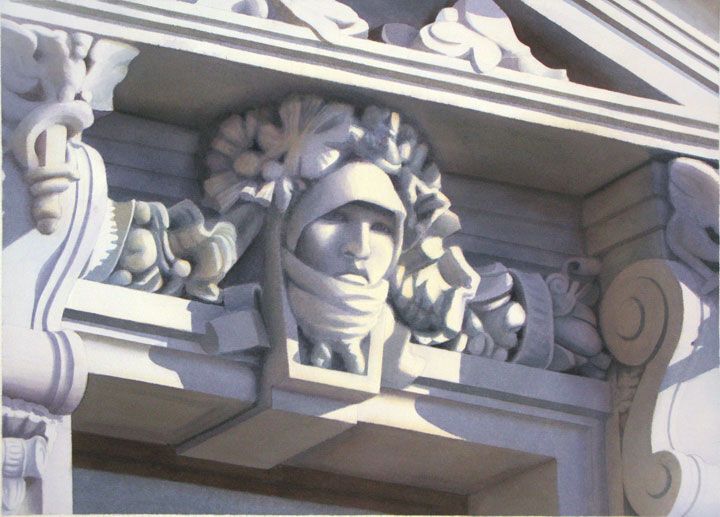
US Custom House
30 x 22 in
(76.20 x 55.88 cm)This watercolor, “US Custom House,” focuses on one of the carved heads set above the windows of the Alexander Hamilton U.S. Custom House at Bowling Green in Lower Manhattan. Cass Gilbert designed the building, which rose between 1902 and 1907 as headquarters for the Port of New York's customs operation. Daniel Chester French's four seated continents - America, Asia, Europe and Africa - sit at the entrance. Above the windows of the main facade are eight keystone heads representing what was then described as the “eight races of mankind.” This figure is hooded, the drapery wrapped closely at the throat, and set within a wreath of fruit, shells and feathers beneath a heavy cornice. The painting is worked almost entirely in gray-blue and violet, with warm light catching the upper edges and the cornice above. The deepest shadow falls across the eyes, leaving the face partly concealed. The customs service moved out in the 1970s. Since 1994, the building has housed the Smithsonian's National Museum of the American Indian. The eight heads remain above the windows. This is the first of several paintings from this building. * Framing: Framed; frame not shown * Room view: For scale and presentation only
$3,800
US dollars
US Custom House II
22 x 23 in
(55.88 x 58.42 cm)"US Custom House II" focuses on a laurel-crowned head above the main entrance of the Alexander Hamilton U.S. Custom House at Bowling Green, in Lower Manhattan. Cass Gilbert designed the building, which rose between 1902 and 1907 as headquarters for the Port of New York's customs operation. Since 1994 it has housed the Smithsonian's National Museum of the American Indian. Unlike the stronger contrasts of "US Custom House," this painting is built from reflected light. Soft lavender, gray, ochre and pale yellow move across the stone, with warmer light gathering along the face and the projecting edges of the ornament. The shifts are subtle, but they separate one form from another and give weight to the tightly interlocking shapes. Shadow is usually cooled to push it back. Here it was underpainted warm, so the recesses hold light instead of losing it. Selected for Splash 13: The Best of Watercolor, Alternative Approaches, edited by Rachel Rubin Wolf. * Framing: Framed; frame not shown * Room view: For scale and presentation only
$3,300
US dollars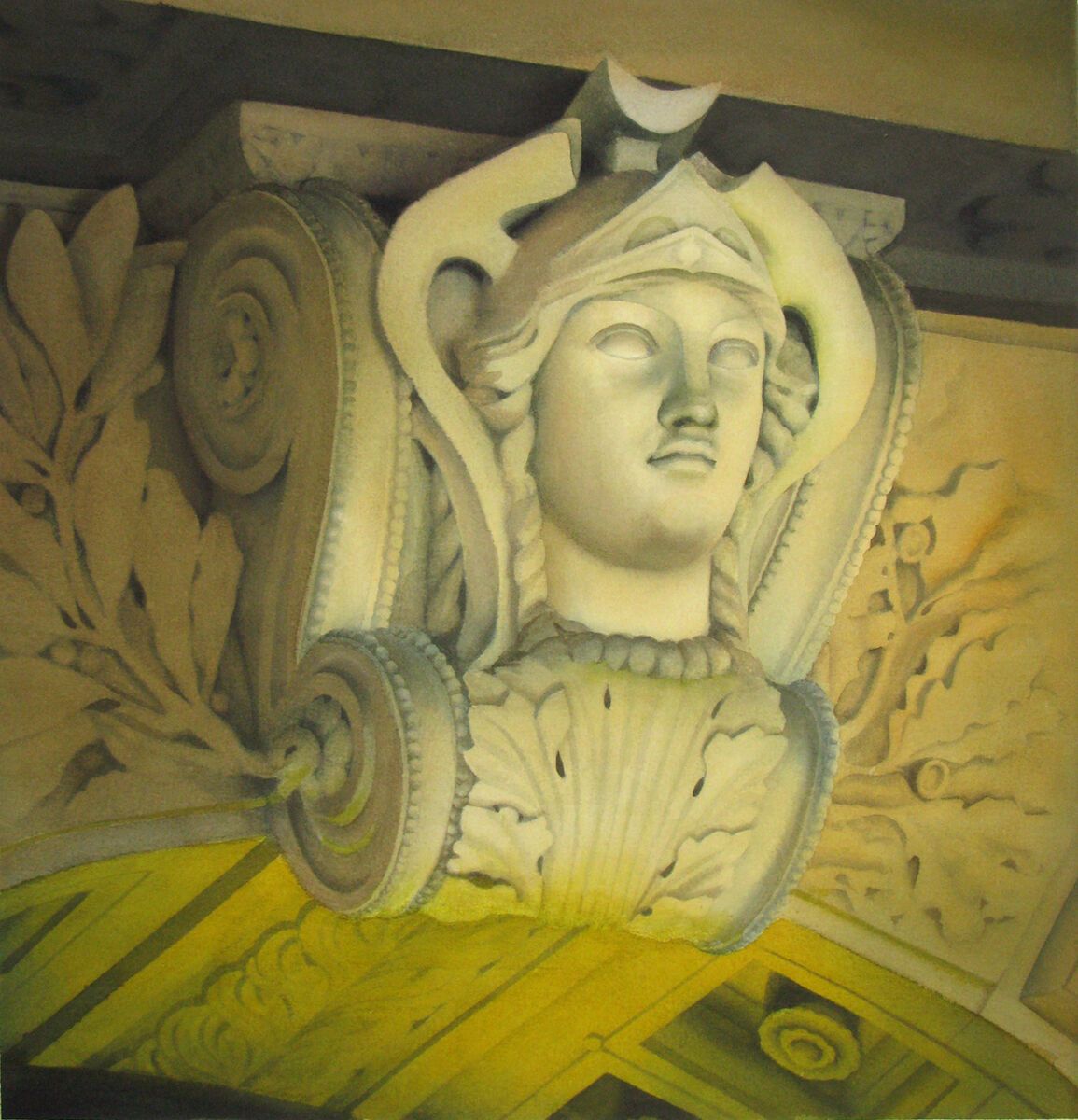
the University Club of NY
20 x 20 in
(50.80 x 50.80 cm)This watercolor focuses on the carved head of Pallas above the main entrance of the University Club at 1 West 54th Street in Midtown Manhattan. Set within an elaborate arrangement of scrolls, foliage, and classical ornament, her pale face emerges from the architecture under the warm light of night. The University Club was designed by Charles Follen McKim of McKim, Mead & White and completed in 1899, an Italian Renaissance palazzo modeled on the Strozzi Palace in Florence. McKim clad it in pink granite instead of the expected white marble, and composed the facade so the building reads from the street as three grand horizontal levels. The seals of eighteen universities are carved across the facade. All three partners of the firm were members of the club, designing their own clubhouse. The painting is built around a restrained contrast of warm gold and cool gray-green. The light rises from below, from the entrance beneath: the chin, throat, and leaves below the face hold the brightest passages, while the brow and upper eye sockets drop into shadow. The close cropping removes almost all sense of the building's monumental scale, leaving Pallas suspended within the curves and foliage around her. A goddess of wisdom, set above the entrance to a club chartered in 1865 for the promotion of literature and art. * Framing: Framed; frame not shown * Room view: For scale and presentation only
$3,300
US dollars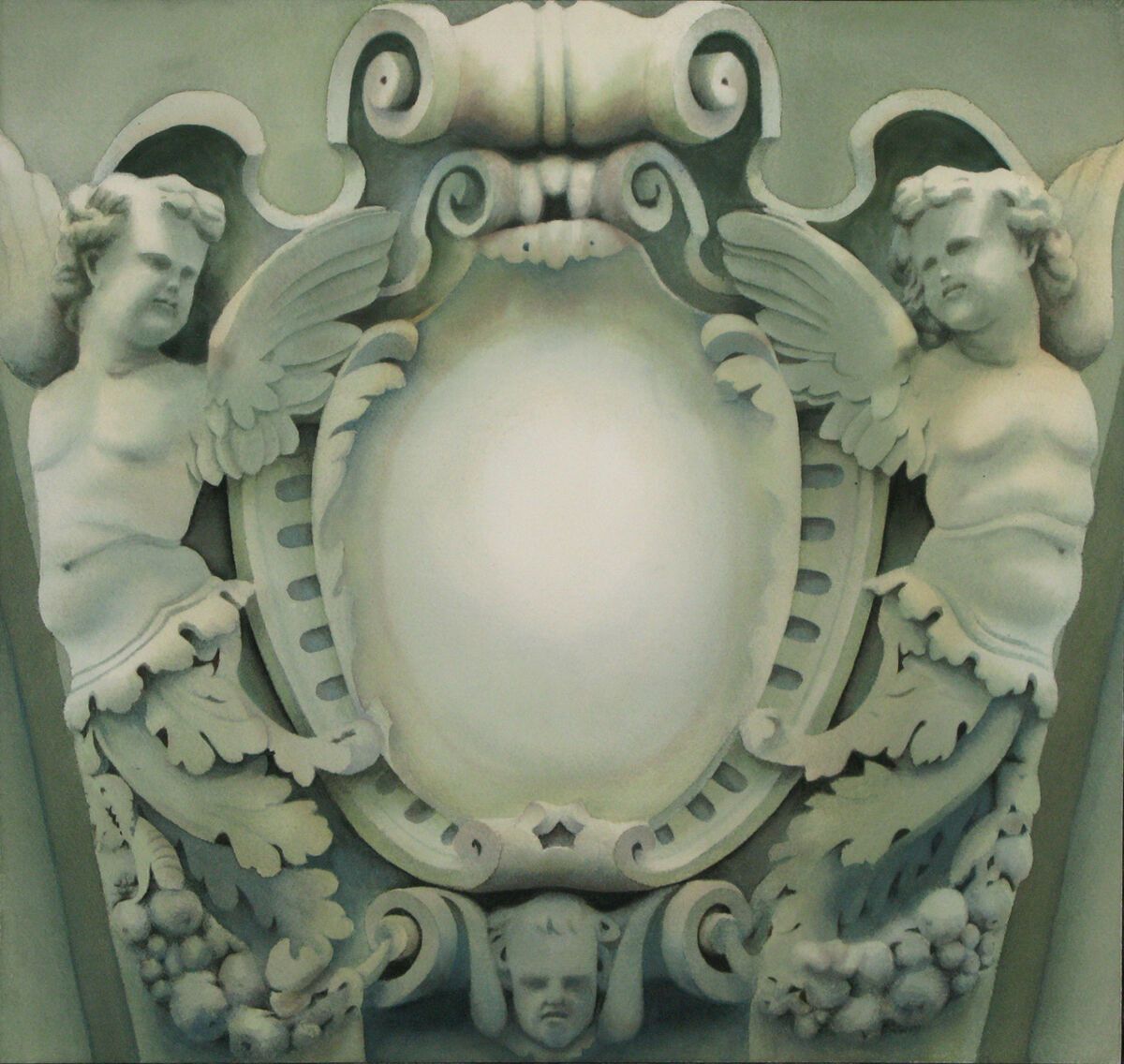
The Belnord
20 x 20 in
(50.80 x 50.80 cm)This watercolor focuses on the carved cartouche above one of the entrances of the Belnord at 225 West 86th Street on Manhattan's Upper West Side. Two winged putti flank an oval shield. The shield is blank. The building was designed by Hiss & Weekes for the Belnord Realty Company and completed in 1909 in brick and Indiana limestone, in the Italian Renaissance style. It fills the entire block between 86th and 87th Streets, Broadway and Amsterdam Avenue. Contemporary press called it the largest apartment house in the world: 175 apartments, more than two thousand rooms, and an expected population of over twelve hundred. Its enormous interior courtyard was also the largest of its kind. The painting holds almost everything within a single range of moss green and gray. The deepest values sit in the niches behind the putti and in the small face below the shield. The palest and smoothest passage is the empty oval at the center, where the light collects. A cartouche is made to carry something: a monogram, a date, a coat of arms, a name. This one carries nothing. The Belnord was designed so residents could drive through monumental entrance gates and cross the private courtyard to their doors, removed from the street outside. Above the entrance they passed through, a shield that names no one. * Framing: Framed; frame not shown * Room view: For scale and presentation only
$3,300
US dollars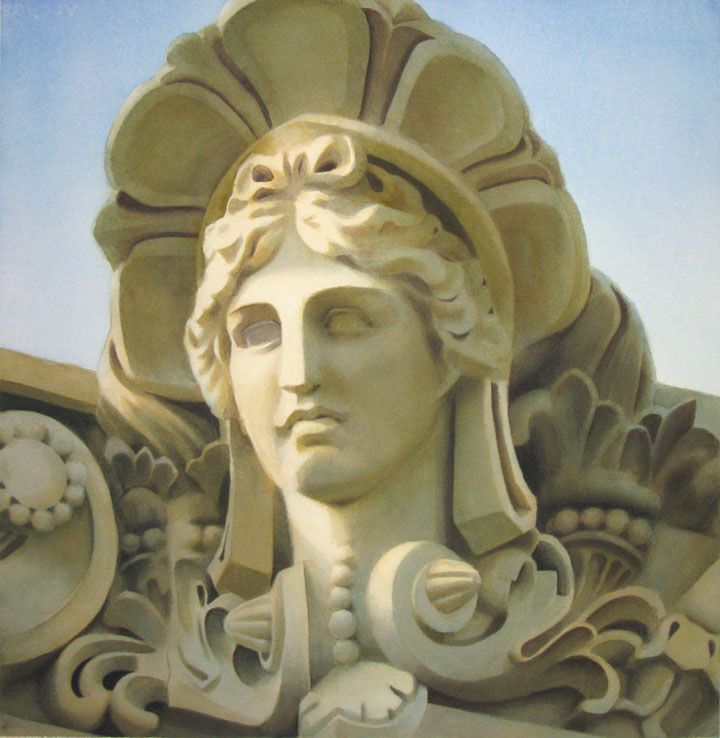
The Metropolitan Museum of Art
20 x 20 in
(50.80 x 50.80 cm)This watercolor focuses on one of the sculpted heads along the roofline of the Metropolitan Museum of Art, on Fifth Avenue in New York City. The Fifth Avenue facade was designed by Richard Morris Hunt, who died in 1895 shortly after completing his plans and never saw it built. His son, Richard Howland Hunt, oversaw the completion of the central entrance block in 1902. Hunt had envisioned the facade in white marble, but Indiana limestone was ultimately used. Seen from the sidewalk far below, the head registers as a pale shape against the open sky. Late-afternoon light moves across it from one side, warming the stone and separating the face from the palmette behind it. The tight framing brings this distant architectural detail into direct view, giving the face a presence of its own. The head recalls the ancient tradition of the antefix — an ornament set along a roofline, often combining a face with a palmette. Greek and Etruscan temples were lined with them, the same face repeated the length of the roof so it could be read from the ground. Several terracotta examples sit in the museum's own galleries. The building carries the same idea along its roofline, in limestone, centuries later. * Framing: Framed; frame not shown * Room view: For scale and presentation only
$3,300
US dollars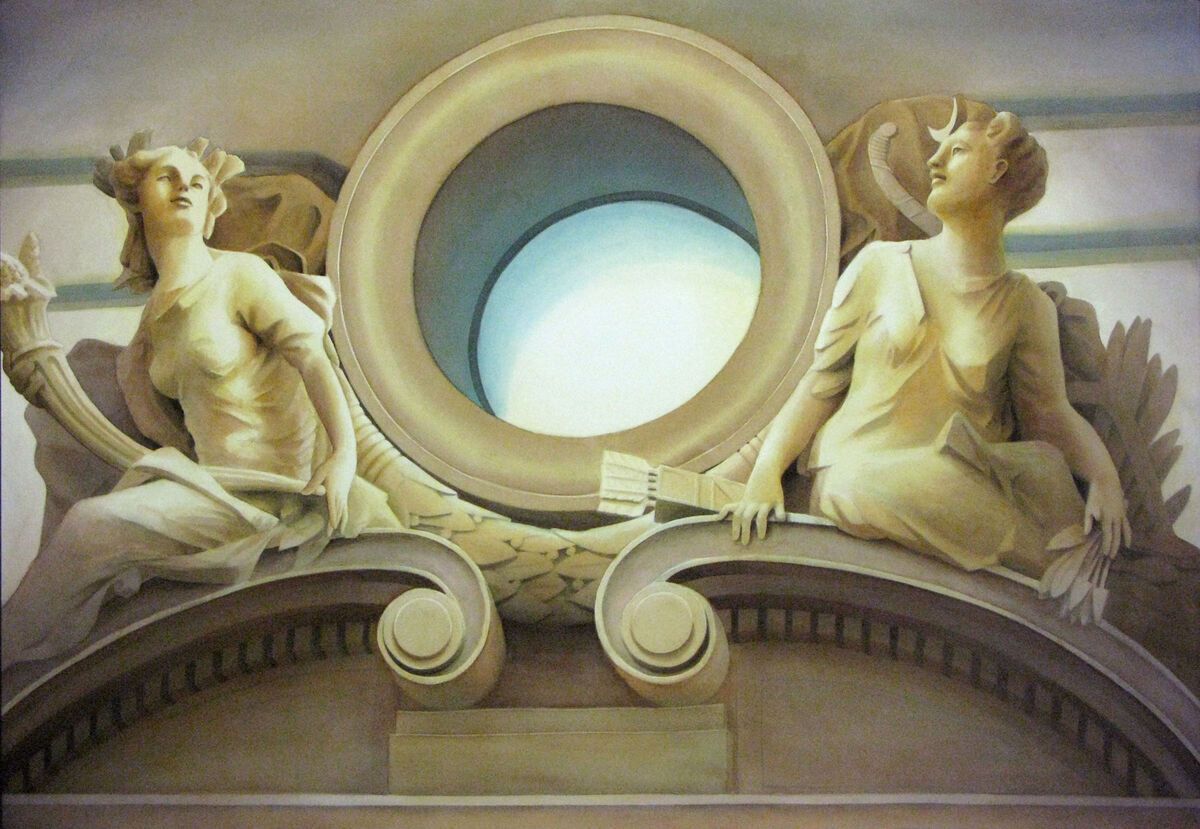
Peninsula Hotel III
43 x 30 in
(109.22 x 76.20 cm)"Peninsula Hotel III" focuses on a pair of sculpted figures flanking the bull's-eye window above the main entrance on West 55th Street in New York City. It is the third in a series painted from this facade, following earlier paintings of the individual figures, and the first to include the circular window, an opening that seems to lead somewhere else. The building opened in 1905 as the Hotel Gotham, designed by Hiss & Weekes, former employees of McKim, Mead & White and faced in limestone to harmonize with McKim's University Club directly to the south. At twenty-three stories, it was among the earliest of the "skyscraper hotels" and one of the first in the city built on a steel frame. The original venture lasted only three years. The Gotham was foreclosed in 1908, having failed to obtain a liquor license. Agriculture and the hunt, provision and plenty, set above the door. The figures are Ceres and Diana. Ceres tips her head back, a cornucopia at her shoulder; Diana wears a crescent moon in her hair and keeps one hand on her bow. Both sit on the outward scrolls of a broken pediment. The painting holds everything in warm cream and ochre except the window, which runs from turquoise to a pale glow at its center. The brightest passage in the picture is the opening itself. * Framing: Framed; frame not shown * Room view: For scale and presentation only
$5,000
US dollars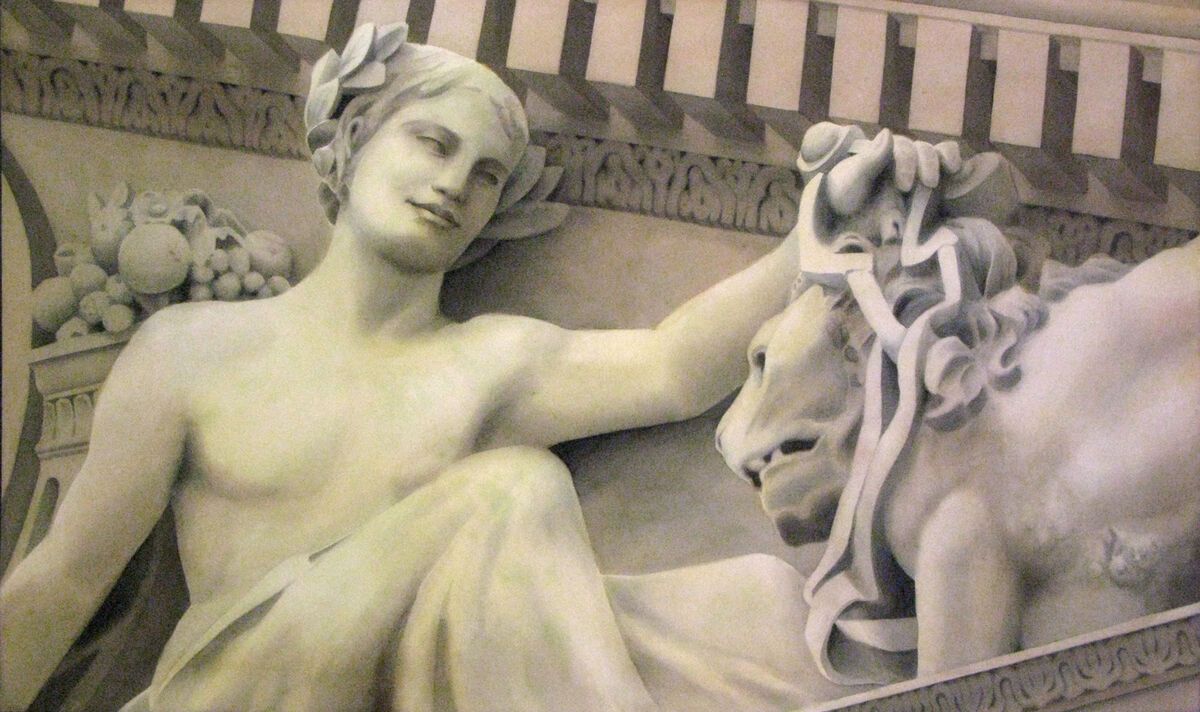
130 Bowery II
44 x 26 in
(111.76 x 66.04 cm)"130 Bowery II" takes the male figure from the pediment of the former Bowery Savings Bank at 130 Bowery, caught in a dynamic pose as he tames a lion. It is one of a pair. The companion painting, "130 Bowery," takes the female figure on the opposite side of the pediment's central clock and is in a private collection. The two sculptures stand for Time and Industry. Stanford White of McKim, Mead & White designed the bank, built between 1893 and 1895. He chose a Roman classical style, a first for an American bank, and it became the standard for bank buildings across the country. The facade carries Corinthian columns and sculpted pediments by Frederic MacMonnies. The Landmarks Preservation Commission's designation report notes that the architects used sculpture wherever they could, and describes the clock as flanked by reclining classical figures and domesticated lions. The Bowery Savings Bank lost its own name in 1992. Since 2002 the building has been an event venue, and the figures have held their positions above the entrance the entire time. * Framing: Framed; frame not shown * Room view: For scale and presentation only
$5,000
US dollars
704-706 Broadway
42 x 27 in
(106.68 x 68.58 cm)This watercolor focuses on two reclining nude figures set above the seventh floor of the Boskowitz Building at 704–706 Broadway in New York City. Built in 1894–95 for developer Adolf Boskowitz, the ten-story store and loft was designed by De Lemos & Cordes in gray brick, limestone, and terracotta. The architects would soon go on to design the Siegel-Cooper store and Macy's at Herald Square, each the world's largest department store when it opened. Seen from the street far below, the figures are easily missed. The painting isolates them from the facade and brings them close. Cool blue-gray shadows echo the summer sky while warm late-afternoon light moves across their forms. Nothing in the frame establishes their scale beyond the column shafts and the cornice on which one figure rests. Placed seven floors above busy Broadway, the sculptures have quietly watched over the city for more than a century, largely unnoticed by the movement below. The ornate cornice that once crowned the building is gone. The figures remain. * Framing: Framed; frame not shown * Room view: For scale and presentation only
$5,000
US dollars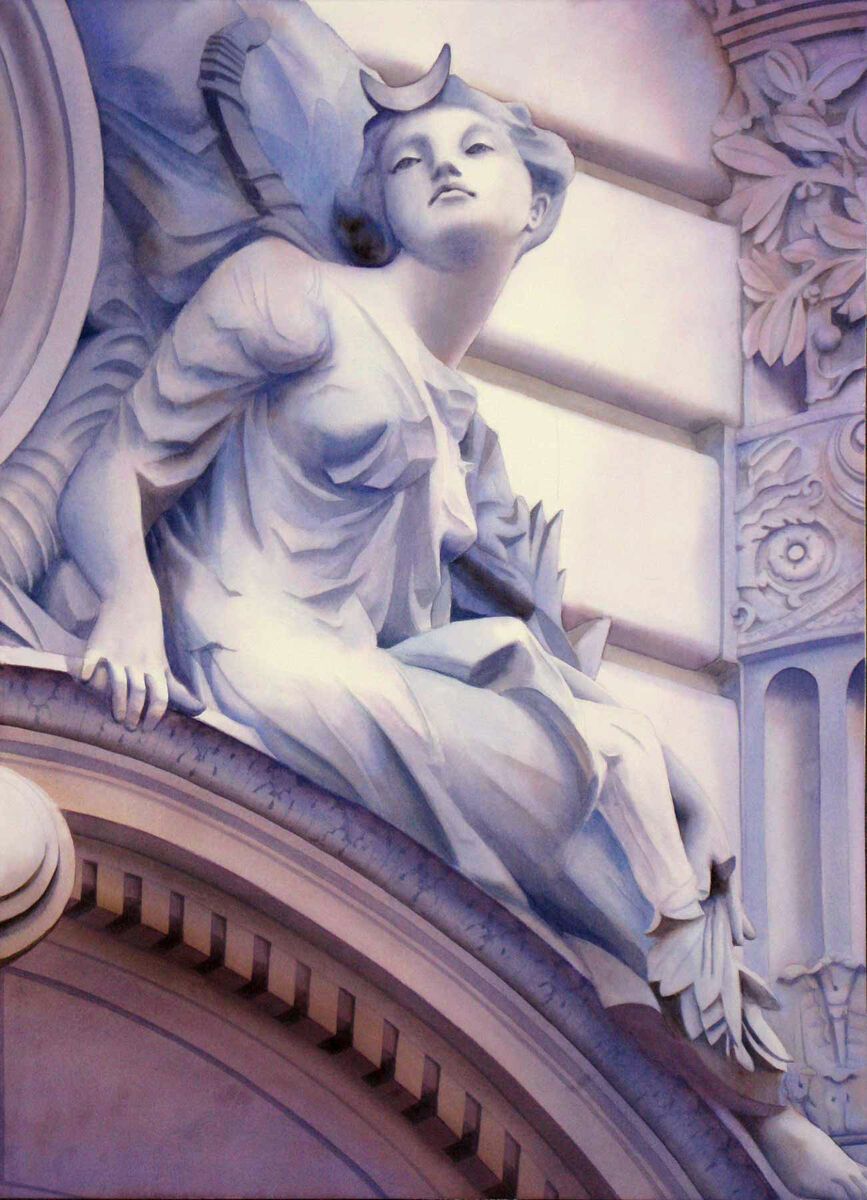
Peninsula Hotel II
22 x 31 in
(55.88 x 78.74 cm)This watercolor, “Peninsula Hotel II,” focuses on Diana, one of the two sculpted figures flanking the bull's-eye window above the main entrance of the Peninsula Hotel on West 55th Street in New York City. She is identified by the crescent moon at her brow. The building was erected between 1902 and 1905 by the Fifty-Fifth Street Company and opened as the Hotel Gotham, at a cost of $2.25 million. It rose at a moment when Fifth Avenue was shifting from a street of private mansions into a commercial thoroughfare, competing directly with the St. Regis across the avenue. The painting emphasizes the upward angle from the street below. Diana twists at the waist, one hand braced behind her on the cornice, her head turned up and away. The cropping is close. From the street she is a pale shape against the wall. Here she fills the frame, holding a pose she has held since 1905. Lavender and cool gray carry most of the painting, while warmer pinks at the shoulder and drapery shift the weight and hold the composition steady. “Peninsula Hotel II” was featured in American Watercolor Magazine. Diana and Ceres were each painted alone before being brought together around the circular window in “Peninsula Hotel III.” * Framing: Framed; frame not shown * Room view: For scale and presentation only
$3,800
US dollars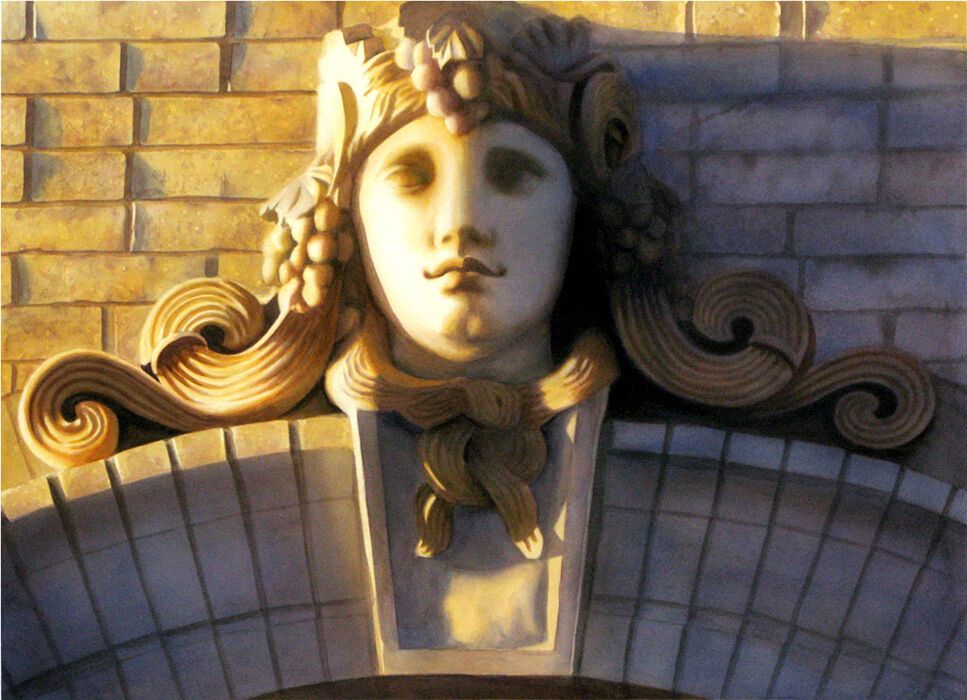
Sunset on 57th Street
28 x 21 in
(71.12 x 53.34 cm)“Sunset on 57th Street” looks up at a terracotta head above a window at 163–165 West 57th Street, a face crowned with grape clusters and vine leaves. The building was raised in 1916 for Louis Chalif, a ballet dancer from Odessa who arrived in New York in 1904 and opened his school the following year, directly across from Carnegie Hall. He called the building his temple to Terpsichore. His architects, George and Henry Boehm, covered the facade in polychrome terracotta and filled it with imagery of the theater: masks, lyres, faces, griffins, urns. The grapes and vine leaves belong to Bacchus, whose followers danced. 57th Street runs east to west, and late in the day the sun comes straight down it. The painting is split by that light. The brick on the left burns gold; on the right it falls into blue-purple shadow. The face is caught at the divide, warm on one side and cool on the other. A trade magazine wrote in 1916 that the new building had "a golden charm that is all its own." A century of owners later, the terracotta is barely altered, and on a clear evening the phrase still describes it exactly. * Framing: Framed; frame not shown * Room view: For scale and presentation only
$3,800
US dollars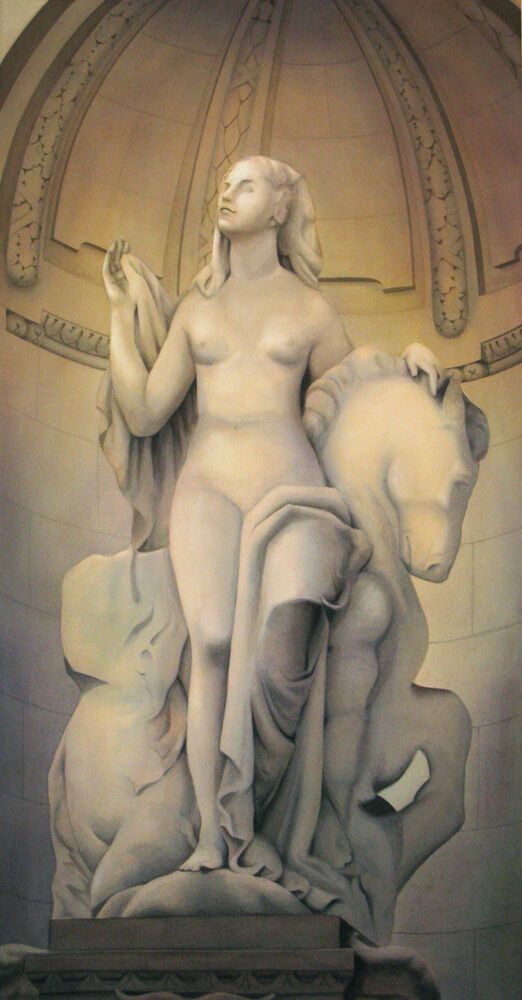
Public Library 42nd Street
25 x 48 inch
(0.00 x 0.00 in)This watercolor focuses on Beauty, the marble figure above the south fountain on the Fifth Avenue facade of the New York Public Library, to the left of the main entrance. The library was designed by Carrère & Hastings and opened in 1911 on the site of the former Croton Reservoir. Frederick MacMonnies was commissioned to create the two allegorical figures flanking the entrance: Truth to the north, seated with a sphinx, and Beauty to the south, accompanied by Pegasus. Both were carved in Carrara marble and placed above terraced basins of Vermont marble. Beauty stands within a shallow niche, Pegasus at her shoulder, one arm raised and drapery falling from her hip. The painting runs warm through the upper half, with ochre and cream across the niche and raised arm, then gradually cools into gray and violet toward the base. Her face remains the palest passage in the composition, which quietly draws the eye upward. Carved above the figure is a line from John Greenleaf Whittier: "Beauty, old yet ever new, eternal voice and inward word." * Framing: Framed; frame not shown * Room view: For scale and presentation only
$5,000
US dollars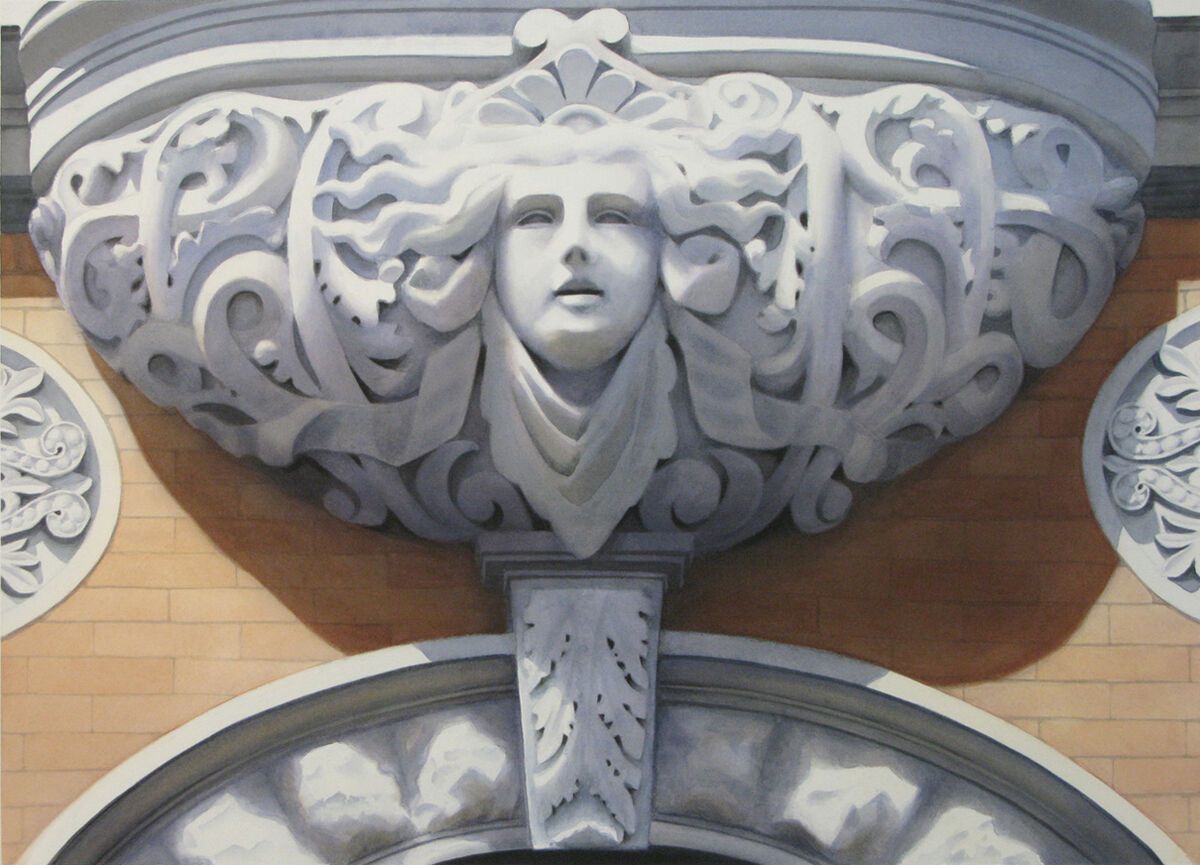
69 8th St.
28 x 21 in
(71.12 x 53.34 cm)This watercolor focuses on the carved face at the center of the fourth-floor balcony of the German Odd Fellows Hall at 69 St. Marks Place in New York's East Village. The face emerges from an elaborate mass of foliage that reads almost equally as hair, becoming the still center of the surrounding curves and ornament. Strong summer light falls almost directly across the facade, separating the pale carving from the warm ochre brick through sharp shifts of value. Gray and lavender move through the stone, while the deep, warm shadow beneath the balcony emphasizes its weight and projection from the wall. The German Odd Fellows Hall was built in 1889-90, when the East Village was the heart of Kleindeutschland, or Little Germany. Its richly carved facade reflects the craftsmanship brought to the neighborhood by its German immigrant community. Unlike much of New York's architectural ornament of the period, which could be molded and reproduced, the stonework here was carved from one massive block by hand. * Framing: Framed; frame not shown * Room view: For scale and presentation only
$3,800
US dollars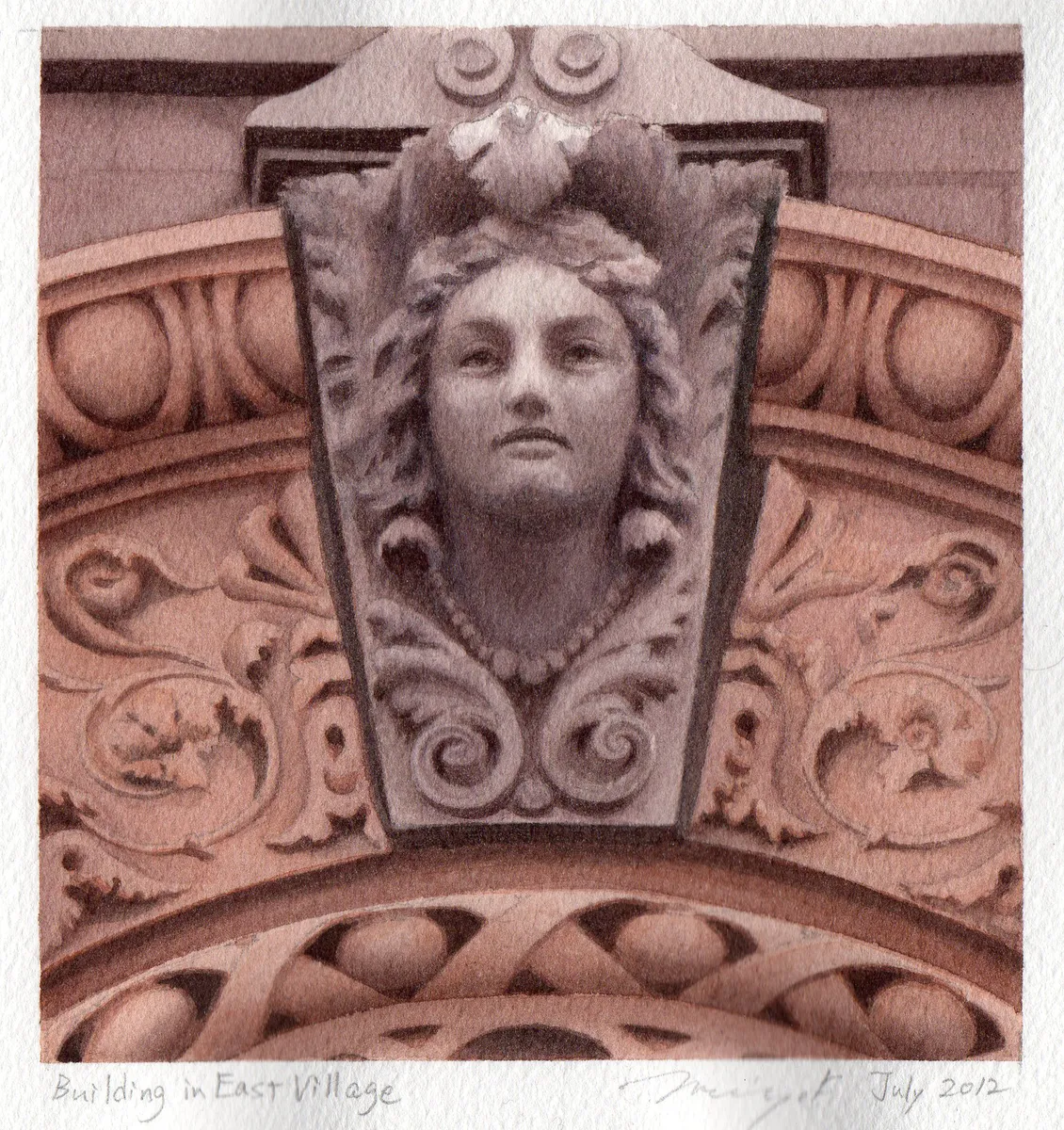
Building in East village
5 x 5 in
(12.70 x 12.70 cm)This watercolor focuses on a sculptural face embedded within the architecture of a building on St. Marks Place in New York's East Village. Seen from below, the figure emerges from layers of ornamental terracotta, surrounded by curves, spirals, and repeated geometric forms. The surround is held in warm tones while the face is cooled toward gray - a separation more pronounced in the painting than on the building itself. The tightly framed composition transforms an architectural detail that might easily be overlooked into a commanding presence. Architectural terracotta ornament of this period was typically modeled in clay and reproduced through molds before being fired and installed on the facade. Ornament of this kind was modeled once in clay, cast from a mold, fired, and installed — the same form repeated across a facade, and sometimes across other buildings entirely. The architects are usually documented. The craftspeople who modeled the figures usually are not. * Framing: Framed; frame not shown * Room view: For scale and presentation only
$800
US dollars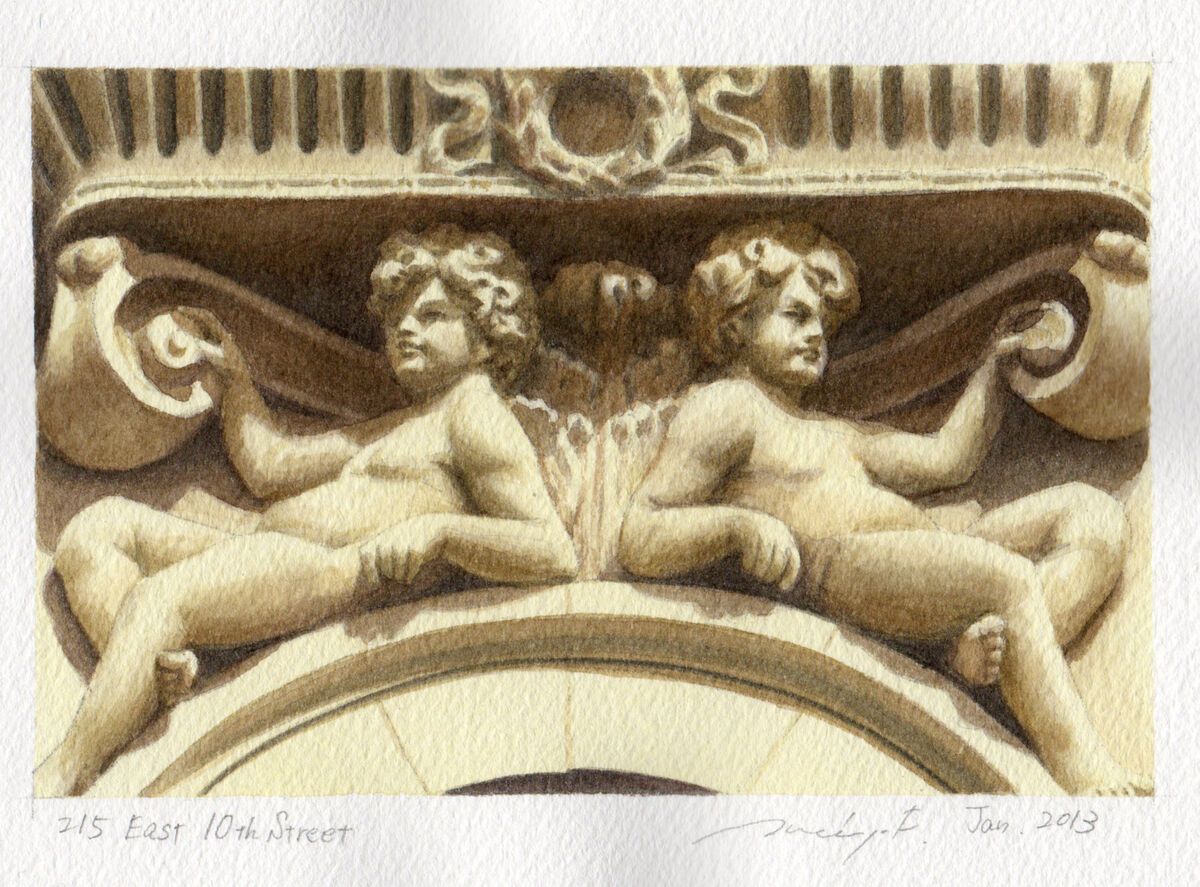
215 E 10th Street
6 x 4 in
(15.24 x 10.16 cm)This small watercolor focuses on two cherubs above an arched window at 215 East 10th Street in New York City's East Village. Leaning into one another, the figures have an unexpected tenderness and companionship, caught here in the bright light of a summer day. The building was designed by Charles Rentz in 1891 as one of a group of six-story brick, stone, and terracotta tenements on East 10th Street. Cherubs, or putti, appear abundantly on these facades. The neighborhood was then Kleindeutschland, or Little Germany, which for part of the 19th century held the largest German population anywhere outside Europe. The painting is small — smaller than the carving itself. A detail passed daily without notice, brought close enough to see how the two figures are holding each other up. * Framing: Framed; frame not shown * Room view: For scale and presentation only
$800
US dollars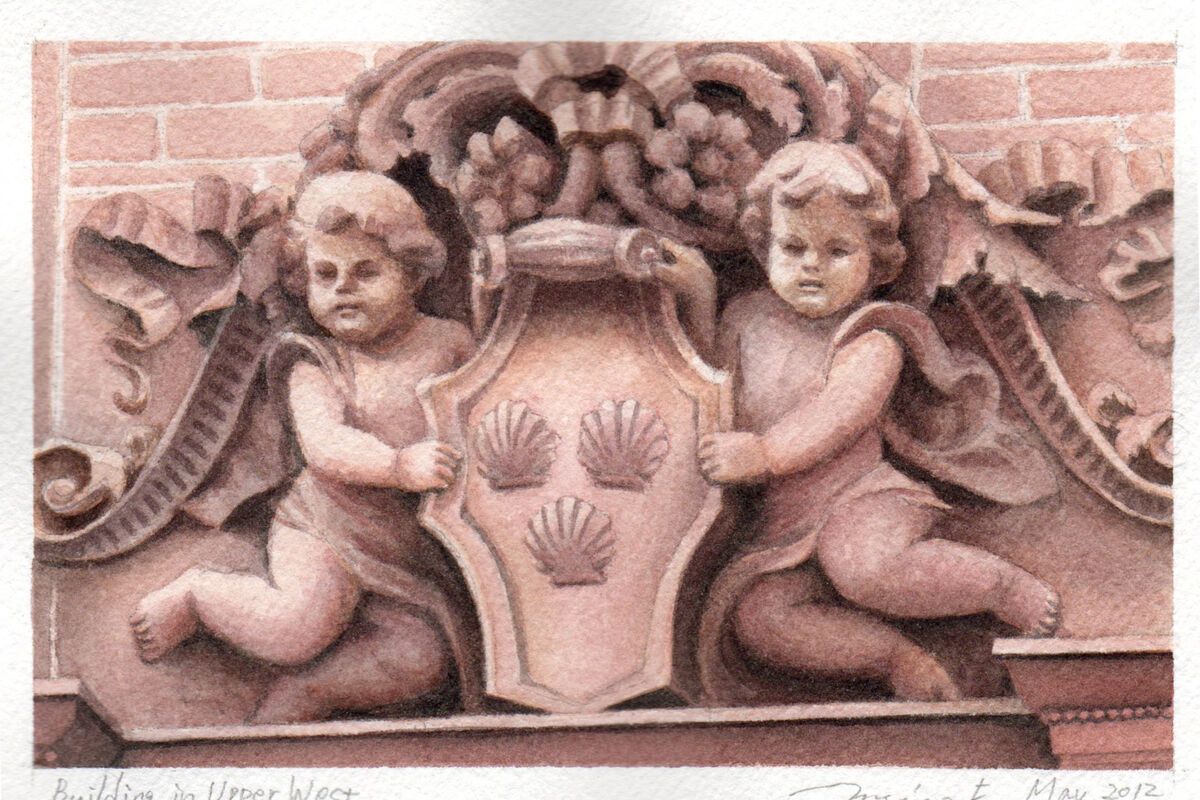
Building in Upper West
6 x 4 in
(15.24 x 10.16 cm)This watercolor focuses on an elaborate architectural relief on a historic building on New York City's Upper West Side. Two cherubs flank a shield bearing three scallop shells, surrounded by scrollwork, foliage, and layered ornamental forms. Layered washes of muted Burnt Sienna, soft red, and weathered grays evoke the patina of aged stone. The transparency of watercolor allows light to move through the surface, suggesting sunlight diffused across the relief and emphasizing its carved depth and texture. Rooted in Beaux-Arts and Renaissance Revival traditions, the ornament reflects the craftsmanship embedded throughout the neighborhood's historic architecture. Isolated from the larger facade, the relief becomes a quiet study of guardianship, history, and beauty enduring within the changing city. * Framing: Framed; frame not shown * Room view: For scale and presentation only
$800
US dollars